The technology already exists for the transition to a renewable-based energy system. However, energy systems based on renewables are fundamentally different from traditional systems. In contrast to fossil fuel power plants, wind and solar plants have high investment costs (CAPEX) but very low, close to zero, operational costs (OPEX). As a result, the financial viability and rapid deployment of renewable energy projects depend heavily on securing predictable and stable revenue streams.
In addition, as the share of renewables in the electricity mix increases, the so-called cannibalisation effect emerges: when large amounts of wind and solar are generating simultaneously, they decrease the marginal price of the system and depress wholesale market prices, precisely at the times when these plants are producing the most. This dynamic reduces the marginal value of renewable generation and makes it more challenging for projects to ensure stable and sufficient revenues over their lifetime. Both regulated and liberalised power systems share the challenge of reformulating their procurement and allocation mechanisms to support the post-transition power system and to facilitate the transition process itself (IRENA, 2022d).
In addition, a renewable-based energy system can have many more generation sites, which typically are smaller and much more widely distributed than large centrally located power plants. This decentralises the system and can also empower consumers. Furthermore, integrating very large amounts of variable electricity generation is a challenge that asks for increased operational flexibility, and therefore new regulations to enable and remunerate this flexibility.
Innovations in regulations and market designs are key to incentivise the deployment and integration of large shares of renewables. These regulations and market designs must also provide the right incentives to invest in and operate the renewable power system, including ensuring sufficient economic returns for the investments made. This need for innovative market designs and regulations is particularly acute in developing countries, which must rapidly expand their power sectors to meet the growing electricity demand and to increase access to reliable power.
At the same time, with increased decentralisation and off-grid solutions to address the lack of energy access, countries often must manage the development of both mini-grids and main grids, while also transitioning from nationally operated power systems to regional or continental systems. Without strong and supportive institutional and regulatory frameworks, they could end up with costly stranded assets. For example, cross-border trades in West Africa could be an important strategy for integrating large amounts of VRE, but their potential has been largely untapped because the necessary regulatory framework has yet to be developed (World Bank, 2025c). Similarly, private sector investments in renewable generation have been hampered by the high cost of finance and the lack of a clear regulatory framework, despite impressive cost reductions in wind and solar technologies. Figure 26 shows that the majority of African countries are still at low or medium levels of regulatory development, according to a measure called the Electricity Regulatory Index (ERI) (AfDB, 2021c).
FIGURE 26 Electricity Regulatory Index for African countries
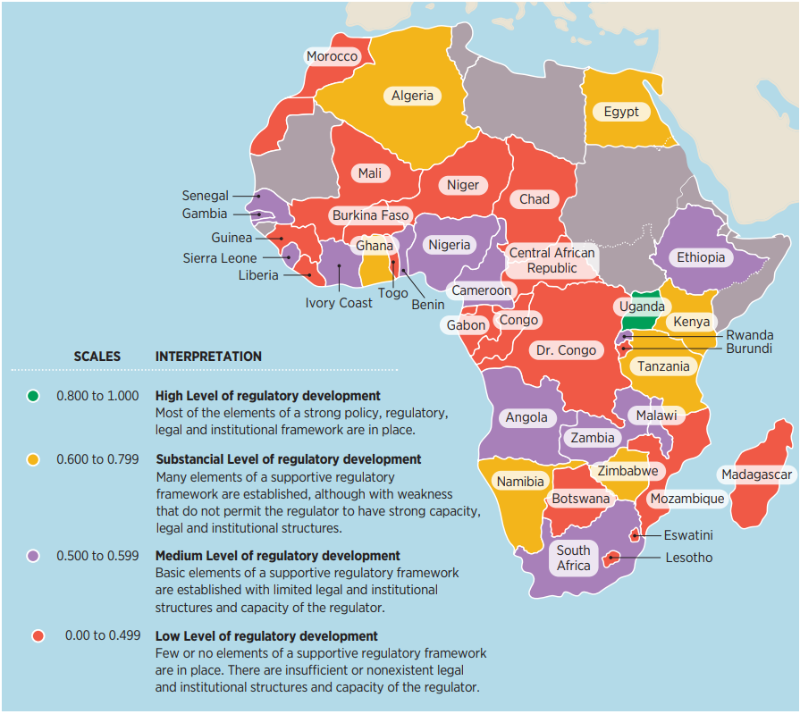
Disclaimer: This map is provided for illustration purposes only. Boundaries and names shown on this map do not imply the expression of any opinion on the part of IRENA concerning the status of any region, country, territory, city or area or of its authorities, or concerning the delimitation of frontiers or boundaries.
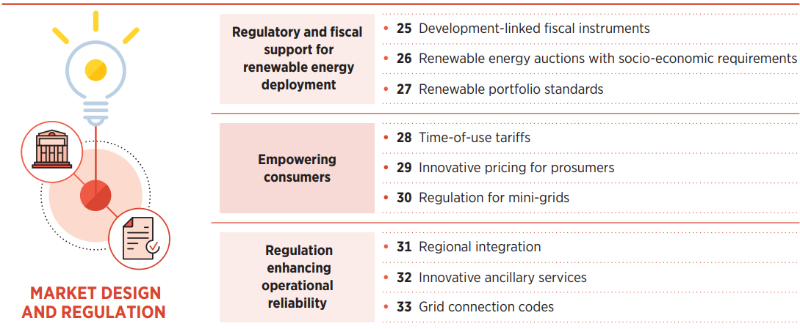
This section identifies nine regulatory and market designs innovations that can accelerate the energy transition and support sustainable development based on renewable solutions (Figure 27). The innovations are divided into three categories: regulatory and fiscal support for renewable energy deployment, empowering consumers, and regulation enhancing operational reliability.
FIGURE 27 Innovations in market design and regulation
4.1 Regulatory and fiscal support for renewable energy deployment
There are several policy instruments that can support the deployment of renewables, targeting either specific technologies or specific actors, such as industries, households and independent producers. Their main objective is to improve the profitability of renewable energy projects. This section focuses on three types of policy tools that have proven their worth in emerging economies: fiscal instruments, auctions and renewable portfolio standards.
4.2 Empowering consumers
Emerging innovative regulations aim at empowering consumers, involving end users that can promote faster growth of renewable energy solutions. Providing incentives for consumers to shift their energy consumption away from the typical evening peak demand period can reduce the need for back-up plants in a high renewable power system, for example. Consumers can also become energy producers (or “prosumers”) themselves with systems such as rooftop solar and mini-grids. The following sub-sections describe innovative designs that can empower consumers, integrate prosumers and enable demand-side flexibility.
4.3 Regulation enhancing operational reliability
Electricity supply and demand must be instantaneously balanced, and key physical variables such as voltage and frequency must remain within safe operational margins. Integrating large amounts of VRE increases these challenges and introduces new ones, such as the need for larger reserves and other sources of flexibility.
Strategies for enhancing the reliability of power systems are thus crucial. To be most effective, the strategies should strike the right balance between the amount of reserves and their total cost, determine what ancillary services are needed as levels of VRE increase, set compliance rules for grid connection, and take advantage of the potential contributions of regional integration.
This section focuses on three regulation or market design innovations to enhance the reliability of renewable energy-based power systems in countries: regional integration, innovative ancillary services and grid connection codes.