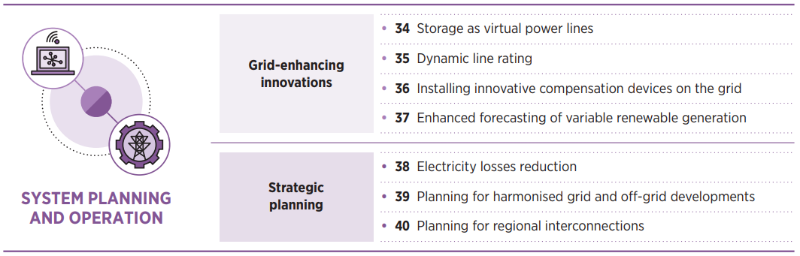
While advances in renewable technologies, supportive regulations, and innovative business models are critical for accelerating the energy transition, they must be complemented by equally important innovations in power system operation and planning. In power systems with weak grids and large energy access deficits, integrating VRE requires smarter ways of managing and expanding the system. This section proposes innovative ways to enhance the grid infrastructure with non-wire alternatives, as well as innovations for strategic planning suitable for systems with weak grids and energy access deficit (Figure 36).
FIGURE 36 Innovations in system planning and operation
5.1 Grid-enhancing innovations
Grids are being termed as the new bottleneck in the energy transition and as one of the barriers to the integration of high shares of renewable energy. Current grids increasingly suffer from congestion, often causing curtailment of wind or solar power due to bottlenecks.
The timeline for constructing grid assets such as overhead transmission lines, in developed economies, averages around three years, with planning and permitting for the same taking up to seven years. Payback period for transmission assets vary from 20 to 40 years (IEA, 2023a; LaRiviere and Lyu, 2022). This could be exacerbated with supply chain issues delaying it further. And often, when finally constructed, the grid updates become quickly insufficient due to constantly increasing demand.
The expansion of transmission assets is impeded by lack of clarity on cost allocation, community and environmental concerns, and competitive generators. With higher shares of renewables and increasing electricity demand, there is a need reinforce existing grids, in addition to expanding and building new ones.
Transmission systems have significant untapped potential, which can be unlocked with relatively inexpensive technologies. For example, advanced power flow control technology can reroute electricity in milliseconds to bypass congested circuits, while dynamic line rating (DLR) devices monitor transmission lines to figure out when those lines can handle more current than they are normally rated to carry (Carey, 2024). These approaches can make it possible to defer costly infrastructure investments, improve system reliability, integrate more VRE, and reduce power cuts and blackouts. The following sub-sections focus on four of those innovations: storage as virtual power lines, dynamic line rating, compensation devices and enhanced forecasting of VRE.
5.2 Strategic planning
The power sector includes a wide mix of technologies and very long time horizons. Many decisions made now – such as grid extensions, changes in system operations and expansions of renewable generation – will greatly affect the development of the sector, the success of countries in meeting their electricity access and decarbonisation goals, and the profitability of investments made by project developers. The major uncertainties that exist about those decisions and their effects raise substantial risks for project developers, who are seeking the most cost-effective and profitable investment options today.
These risks and uncertainties can be greatly reduced by establishing strategic long-term plans, which will help all stakeholders make better decisions. This is especially true for countries with increasing demand, as they expand their power systems and implement diverse sets of policies to support renewable energy deployment.
Developing a roadmap with long-term renewable energy targets and pathways, as well as establishing a clear regulatory framework, are key to ensure consistent policy direction, signal opportunities for local value creation, and provide predictability for investors, suppliers, developers and all other players. This roadmap should focus on strategic technologies for the country, based on a careful assessment of local natural resources, local value creation and the existing industry’s capacity to adapt to evolving demand.
Another important planning element is that, instead of merely aiming for minimal electricity or energy access, roadmaps and demand projections in many countries need to be reformed to intentionally plan for more productive uses. This also means that ministries of energy should broaden their perspective beyond only larger projects to consider the diverse and complex needs across different value chains and local contexts for productive uses of energy (IRENA, 2025a). The benefits of such strategic plans include making better use of renewable resources, attracting more investments, reducing future needs for capacity by minimising losses, and developing a common vision of the future power sector (Pfeifenberger et al., 2021).
In addition, including climate resilience in power system planning becomes key. Grid modernisation efforts should go hand-in-hand with resilience building – through infrastructure upgrades, protective equipment, climate-proofing design and the integration of decentralised systems such as mini-grids for remote areas (IRENA, 2025a).
The following sub-sections describe three innovative strategic planning solutions: electricity losses reduction, planning for harmonised grid and off-grid developments, and planning for regional interconnections, whether between countries or between multiple sub-national grids.