1.2 Renewables for energy access and inclusive local development
Despite huge progress in access to modern energy over the past decades, 666 million of the world’s people still lack access to electricity. Access deficits have been shrinking in Eastern Asia and Southeastern Asia, as well as in Central Asia and Southern Asia – thanks largely to policy measures and rising incomes. However, in Sub-Saharan Africa, the number of people lacking access continues to grow at a rate of 14 million people yearly, with gains in access outpaced by rapid population growth. Energy access remains low in many parts of Sub-Saharan Africa, with some 565 million people in the region still lacking access to electricity in 2023, representing 85% of the global population without electricity access (IEA et al., 2025).
At the same time, Africa had only a total of 20 gigawatts (GW) of solar capacity installed in 2025, and only 9 GW of wind, which together represented less than 10% of the region’s total installed electricity generating capacity (IRENA, 2024a; Jowett, 2025).
All of this makes Sub-Saharan Africa home to the world’s largest population without access to modern and clean energy. Beyond electricity access, the affordability and reliability of electricity supply and higher-quality fuels are major issues across the continent. This comes at a significant economic cost, hindering the development of local industries and the delivery of crucial public services, including education and health care. Historically, even fossil fuel-exporting countries in the region have continued to experience large energy access deficits, especially in rural areas (IEA et al., 2024).
The success of the energy transition will, therefore, depend on the extent to which modern energy systems include those last-mile and most remote communities, as well as public facilities (such as health care and education), and encourage productive use activities (such as agriculture).
Achieving this will necessitate targeted policies that not only expand infrastructure but also actively foster demand for productive uses, thereby creating sustainable economic ecosystems in newly electrified areas.
The decentralised nature of many innovative renewable solutions can put universal access to electricity within reach, complementing the centralised grid connections with off-grid energy solutions. Off-grid solutions focused on decentralised renewable energy, such as solar PV mini-grids coupled with batteries, can provide reliable power in areas that are not connected to the central grid, lack energy access and are particularly vulnerable to climate risks.
However, it is important to go beyond providing basic residential electricity access to supporting productive uses of energy in areas such as agriculture, commerce and industries that are vital for sustainable development and job creation. In the period 2010-2021, 63% (USD 1.2 billion) of off-grid renewable energy investment in Sub-Saharan Africa was directed to residential energy uses – that is, to provide basic energy access to households in remote areas (IRENA, 2024b).
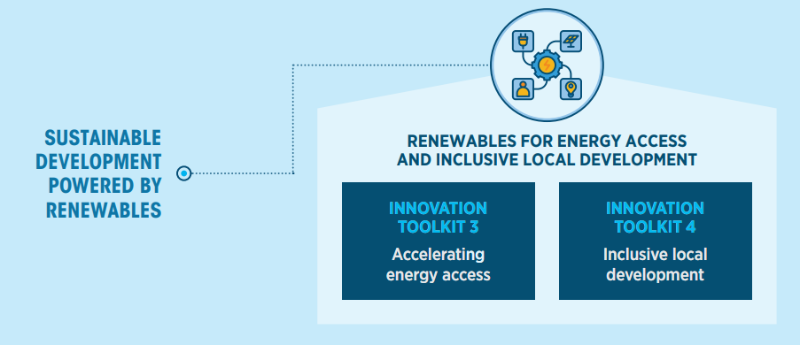
Within the innovation toolbox, two toolkits are designed to support accelerating energy access and inclusive local development. These toolkits are strongly interconnected: reliable energy access enables productive applications, while these productive uses in turn generate the demand and revenue that make energy systems economically sustainable, creating a mutually reinforcing cycle where access unlocks opportunity for local development.
'
TOOLKIT 3: Accelerating Energy Access
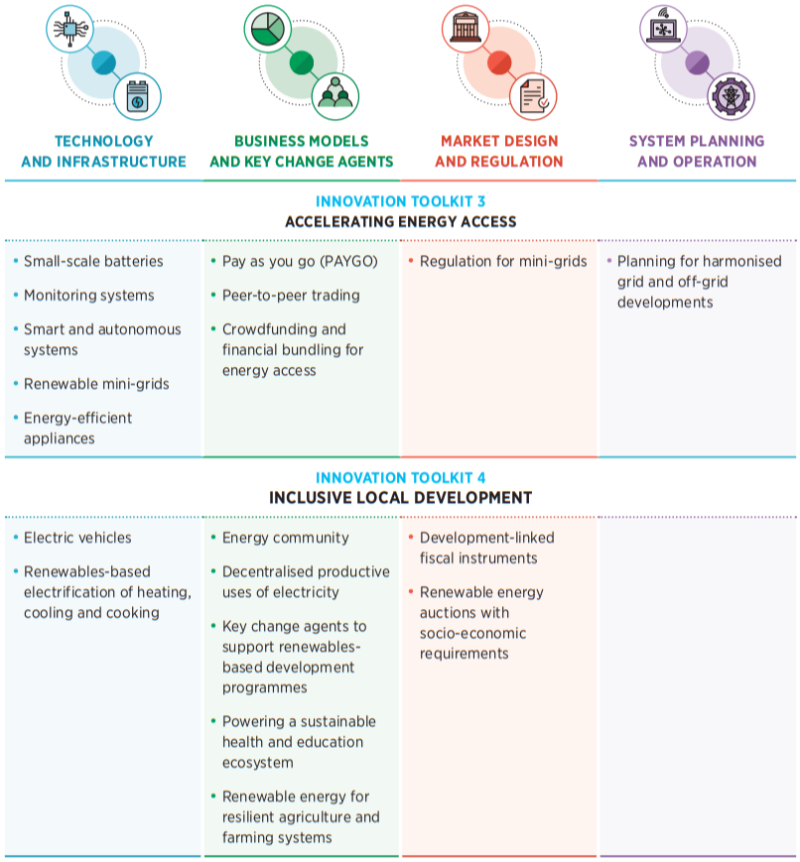
This toolkit focuses on innovations that make energy access affordable and achievable: from payas-you-go financing and peer-to-peer trading to streamlined mini-grid regulations and harmonised planning between grid extension and off-grid solutions.
TOOLKIT 4: Inclusive Local Development
This toolkit goes further, combining renewable electricity with productive uses, such as electric cooking, agricultural applications, powering health and education facilities, and communityled initiatives. These innovations turn energy from a basic service into a catalyst for economic development, job creation and genuine empowerment.
Prioritising productive uses is economically vital as it generates local income streams, enhances the financial viability of off-grid projects, and creates a virtuous cycle of demand and development, making electrification efforts more sustainable in the long term.