Innovation often starts with technology and infrastructure. The renewable energy generation technologies need to be complemented with other innovations to guarantee a reliable supply of electricity based on renewable energy and economically efficient operation of the system. This becomes increasingly relevant with the trend of increased electrification of end uses.
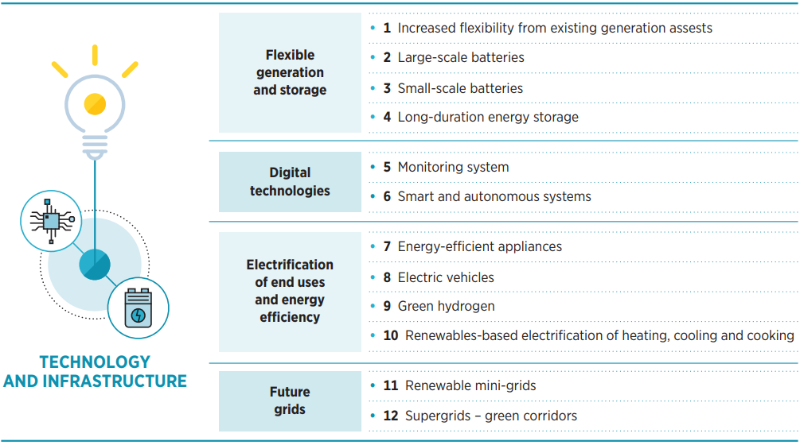
As shown in Figure 2, twelve such innovations are emerging as key, and they fall into four main categories: flexible generation and storage that make it possible to better balance supply and demand; digital technologies; technologies that allow electricity to power many new uses; and new grid systems for renewable electricity.
FIGURE 2 Innovations in technology and infrastructure
2.1 Flexible generation and storage
Innovations in flexible generation and storage can help balance supply and demand in the process, allowing the integration of high shares of renewables. Four key enabling technologies are providing promising solutions to balance supply and demand in power systems: technological improvements in flexibility for existing assets and in large- and small-scale batteries, and long-duration energy storage.
2.2 Digital technologies
Digitalisation is defined as the integration of digital technologies into the planning, operation and management of power systems. This includes the use of sensors, smart meters, communication networks, data platforms and automation tools to improve grid reliability, efficiency, flexibility and customer engagement. Digitalisation makes it possible to monitor, predict, optimise and automate operations across entire power systems (IRENA, 2025a).
Digitalisation is a broad concept that is not limited to a mere substitution of analogue components and techniques by digital ones. Instead, it extends to a wide and evolving range of applications that leverage computational capabilities to enable automation and smart systems. Consequently, digitalisation is not a closed-end task, but a transformational process that takes advantage of innovations in information technologies for adding value to the system where these are applied (IRENA, 2025a).
Digital technologies can support the operation of energy systems with complex and diverse assets through approaches such as optimised forecasting, operation and maintenance. This is expected to lead to efficiency gains, while supporting energy security with enhanced reliability and resiliency. The growing importance of digitalisation is associated with increasing the decentralisation and electrification of end-use sectors. Decentralisation is led by the increased deployment of small power generators, mainly rooftop PV, connected to the distribution grid. Electrification of transport and buildings (heating and cooling) involves large quantities of new loads, such as EVs, heat pumps and electric boilers. All these new assets on the supply and demand sides are adding complexity to the power sector, making monitoring, management and control crucial for the success of the energy transition (IRENA, 2019d).
Power systems have many variables that reflect the state of the systems, such as electricity flows, frequencies and voltages. Monitoring and quickly acting on the information about each of these variables can enable system operators and generators to adjust imbalances between supply and demand, maintain the current frequency and voltage at stable levels, anticipate and prevent problems, reduce costs, and create more reliable and resilient systems. Such data monitoring and analysis become even more critical as power systems integrate higher shares of VRE.
In many regions, however, power grids typically lack advanced data monitoring and control systems, which may result in frequent grid outages, among other issues. A reliability index called the System Average Interruption Frequency Index (SAIFI), which charts the average number of service interruptions experienced by a customer (World Bank, n.d.), starkly illustrates the size of the problem. SAIFI is a ratio of the total number of customer interruptions to the total number of customers served, calculated on a yearly or monthly basis. According to the World Bank, the median SAIFI for the world in 2019 was 2.23. For West African countries on average, it was more than an order of magnitude higher at 27.5, and for a few, it exceeded 50 or even 200 (Niger). The SAIFI was around 4.5 for South America and around 2.7 for South-East Asia (World Bank, 2025a).
To improve reliability, grid modernisation and optimisation are key. Motivation drivers for grid modernisation differ by country to country, and more generally from developed and developing economies. These primarily include system efficiency improvements, enabling new products, services, optimizing system utilisation and utilization improvements (W-T. Paul Wang, 2014) .
Data collection, data management and monitoring are the first steps in digitalising the power system and increasing the visibility of congestion on the grids. Introducing the digital electricity meter (smart meter) is important to enable the collection of energy usage data in an energy system. More advanced digital technologies, such as the Internet of Things (IoT) and artificial intelligence (AI), can increase automation and transform grids into smart grids, enabling increased optimisation of system operations.
Realising the full potential of digitalisation necessitates significant investment in foundational elements such as robust and secure communication networks, interoperable data management platforms, and clear regulatory frameworks governing data access, sharing and cybersecurity. These can be substantial undertakings.
Cyberattacks on smart meters and other devices can cause significant economic losses (Kumar et al., 2019). Combatting cybersecurity risks and maintaining confidence in the power system will require trusted and secure industry standards and skilled technical staff. The European Smart Metering Industry Group (ESMIG) has been promoting technical requirements and certification (Thales Group, 2022) as well as shared best practices (D’Souza, 2021). Similar standards need to be applied throughout the world to enable more digitalised energy systems.
Key concrete steps that policy makers can take to enable the roll-out of digital technologies and to harness the benefits of digitalisation in the power systems are:
- Accelerate digital infrastructure roll-out and ensure interoperability and proper data governance. Ensure access to digital infrastructure such as smart meters and digital platforms. Support digitalisation efforts across the technology layer (smart meters, telemetry, sensors), the data layer (with a focus on interoperability of data) and the regulatory layer (to enable innovative business models and system integration). Addressing the lack of interoperability includes establishing clear data governance, protection and regulation frameworks for data owners when digital solutions are deployed.
- Empower energy consumers and foster their engagement in the energy transition through digital tools and skill-building initiatives. This can be achieved through launching initiatives that enable consumers to become active participants (“prosumers”) and to raise their energy and digital skills. Other key steps are funding hands-on training at the intersection of the digital and energy sectors and supporting upskilling (where expertise is urgently needed).
- Unlock finance in smart grid technologies. There is a recognised lack of investment in smart grid technology. Development banks and funds can specifically invest in data networks, cloud platforms, and edge computing nodes in the Global South, treating digital grids as essential climate infrastructure akin to poles and wires.
- Address and mitigate the risks associated with digitalisation, notably cybersecurity vulnerabilities. Policy makers must manage inherent risks such as cyber vulnerabilities, particularly in critical infrastructure. Specific measures are needed to reduce the energy used by digital solutions, such as implementing reporting obligations, energy labels and minimum energy performance standards for data centres.
This report discusses two innovations that can support the modernisation of existing grids with digital technologies: monitoring systems, and smart and autonomous systems.
2.3 Electrification of end uses and energy efficiency
Electrification of end-use sectors is another innovation trend, with the aim of decarbonising end-use energy sectors and with a great impact on the power system.
Under IRENA’s 1.5°C Scenario, the share of direct electricity in total final energy consumption must increase from 22% in 2020 to 29% by 2030 and 51% by 2050; this can be achieved with tremendous growth in electric-powered technologies, many of which are already available (IRENA, 2023b). They include EVs and heat pumps, which can provide heat for buildings and many industrial processes. In addition, end-use sectors that are difficult to electrify directly can be decarbonised using “green” hydrogen produced by electricity generated from renewable energy, also known as indirect electrification.
The electrification of end-use sectors, which reflects the shift towards electricity as a key energy carrier, combined with renewable electricity generation and increased energy efficiency, is crucial for a successful energy transition (IRENA, 2023c).
Figure 9 shows the major electrification options by end-use sector. The electrification of end-use sectors is not solely driven by decarbonisation targets; it can also support development, decrease air pollution and noise pollution (especially from transport sector) and reduce health issues caused by traditional cooking options in developing countries.
FIGURE 9 Major electrification options by end-use sector
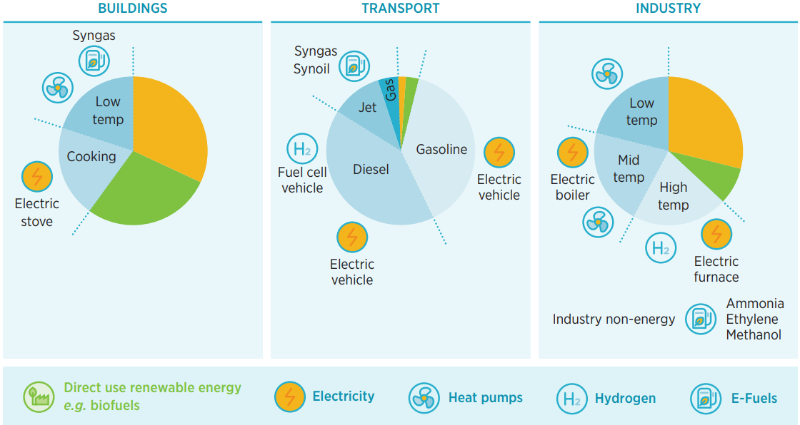
This section focuses on four key end-use areas of innovation: energy-efficient appliances, electric vehicles, green hydrogen, and renewables-based electrification of other end uses (heating, cooling and cooking).
2.4 Future grids
Grids connect generation and demand, often over long distances. Most electric appliances, except for off-grid devices such as solar lamps, must be connected to some sort of grid.
Two very different, yet complementary, grid innovations are mini-grids and supergrids (Figure 12). These grids operate at radically different scales, but both can enable wider adoption of renewablebased electricity in developing countries and can complement each other while supporting existing centralised grids.
FIGURE 12 MEGA and micro perspectives in the setting of the entire power system
Notes: UHV = ultra-high voltage, DC = direct current, AC = alternating current, EHV = extra-high voltage, HV = high voltage, MV = medium voltage, LV = low voltage.
This section focuses on four key end-use areas of innovation: energy-efficient appliances, electric vehicles, green hydrogen, and renewables-based electrification of other end uses (heating, cooling and cooking).